Dynamic Shariah Compliance: An Eight-Quarter Trajectory Study of the S&P 500 (Q1 2024 - Q4 2025)
Halal Terminal Research, July 2026
⚠️ IMPORTANT LEGAL NOTICE (click to expand)
This document is general educational research. It is provided for informational purposes only and does not constitute investment advice, portfolio management, a solicitation, or any inducement to transact in any financial instrument.
No personalization. The analysis does not take into account any individual's financial situation, objectives, or risk profile.
Not a fatwa. Shariah compliance trajectories are computed from public financial disclosures under a specific methodology disclosed in §3. Results are not a religious ruling and should not substitute for guidance from a qualified Islamic scholar or Shariah advisor.
Data and scope. Figures are derived from SEC XBRL companyfacts extractions computed on July 15, 2026, covering the eight calendar quarter-ends from March 31, 2024 through December 31, 2025. Historical compliance trajectories are descriptive and do not imply future compliance status of the same names.
Regulatory positioning. This text is intended to qualify as non-advisory research / educational analysis under Swiss regulatory expectations (FinSA / FINMA), with a focus on methodology, historical evidence, and limitations.
For complete disclaimers, see Legal Disclaimers.
1. Executive Summary
The global Islamic finance industry held USD 5.98 trillion in assets at end-2024 and a projected USD 9.7 trillion by 2029, implying a roughly 10% compound annual growth rate.1 Almost all of that capital is allocated through a binary screen: compliant or non-compliant, attached to a name at a single point in time, refreshed annually or quarterly. The screen is treated as a property of the company. It is not. It is a property of the company at a date, and the date matters.
This study walks 503 published holdings of a leading S&P 500 tracker through eight consecutive calendar quarter-ends (Q1 2024 through Q4 2025), applying the Halal Terminal production screening rules, a documented reading of AAOIFI Shariah Standard No. 21,2 to each name at each checkpoint. Every input is extracted from SEC XBRL companyfacts under the rules in §3, and every figure in this paper can be recomputed from public filings. Of the 503 holdings, 467 are classifiable across all eight quarters and 36 are Unclassified due to incomplete XBRL coverage.
Three headline findings.
First, the distribution is bimodal, with a meaningful transition layer in between. Of the 467 classifiable names, 153 (32.8%) screened compliant in all eight quarters and 238 (51.0%) screened non-compliant in all eight quarters. The remaining 76 names, 16.3% of classifiable names, changed verdict at least once during the window (Improving 9, Near-Improving 10, Oscillating 41, Near-Deteriorating 8, Deteriorating 8). The stable-compliant bucket is a minority of names but carries 46.6% of index weight, because the megacap technology names concentrate there. The 238 stable-non-compliant names split 138 failing on financial ratios and 100 excluded on business activity.
Second, debt drives transitions. Across the window, 145 quarter-to-quarter verdict transitions occurred among classifiable ratio-screened names: 70 from compliant to non-compliant and 75 from non-compliant to compliant. Of these, 110 were debt-only events, 32 were cash-only, and 3 involved both ratios. The debt ratio is involved in 113 of the 145 transitions, which is 77.9%, nearly four in five; cash is involved in 35 (24.1%). Verdict changes in this universe are overwhelmingly records of capital-structure decisions: debt issued to fund acquisitions, debt retired from free cash flow, asset bases growing faster or slower than the debt that funds them.
Third, the 30% line is crowded. Across the 2,936 classifiable ratio-quarters in the dataset (the 367 ratio-screened classifiable names times eight quarters; the 100 business-screen exclusions carry no ratios), 221 (7.5%) show a ratio within 1.5 percentage points of the 30% threshold, spread across 82 distinct names. When one in thirteen ratio observations sits close enough to the line that a defensible change in the debt definition (finance leases in or out, restricted cash in or out) could flip it, a single-quarter verdict near the line is a definition-sensitive claim, not a fact about the company. The correct response is not false precision. It is continuous monitoring, disclosure of the definition, and attention to trajectory: where the ratio has been and where it is heading matters more than which side of the line it sits on in any one quarter.
The rest of the paper develops these findings: the mechanism (§2), the full methodology (§3), the trajectory taxonomy and distribution (§4), five reproducible case studies (§5), the transition-driver decomposition (§6), sector anatomy (§7), implications for ETF construction and monitoring (§8), limitations (§9), and a reproducibility appendix with dataset checksums (§10).
2. Why Verdicts Move
Two mechanisms drive verdict changes under an asset-denominated ratio screen.
The first is balance-sheet motion in the numerators. Companies issue debt to fund acquisitions; they retire debt with free cash flow; they let cash accumulate ahead of buyback windows; they draw cash down to fund capacity. Each of these moves changes a numerator without necessarily moving the asset base by the same proportion, and the ratio crosses the threshold.
The second is the denominator itself. Total assets is what the ratios divide by, and it moves too: a capex cycle builds plant and inventory, a divestiture compresses the balance sheet, an acquisition consolidates the target's assets alongside the debt that funded the deal. None of these movements are price-driven. They are operating decisions, and they push the verdict around even when absolute debt is flat.
The clearest illustration in the dataset is Welltower (WELL), one of the larger US-listed healthcare REITs. Welltower entered the window non-compliant on the debt ratio: debt to assets stood at 31.9% at Q1 2024 and ranged between 30.4% and 32.2% across all four quarters of 2024. Total assets then grew from USD 44.6 billion (Q1 2024) to USD 67.3 billion (Q4 2025) as the senior-housing portfolio expanded, while absolute debt grew more slowly, from USD 14.2 billion to USD 19.2 billion. The ratio fell below 30% at Q1 2025 (29.5%) and stayed below it for the rest of the window, ending at 28.5%.
This is not a denominator artifact. Welltower funded most of the expansion through equity rather than debt, so the asset base outran the debt stack, and the ratio recorded a real shift in capital structure, slowly and durably. That is the general character of transitions under an asset-based denominator: total assets is a slow-moving item, so verdict changes tend to record durable balance-sheet shifts rather than market noise. The point-in-time problem is not a curiosity. It is a structural feature of any ratio screen with a balance-sheet denominator and a moving balance sheet.
3. Methodology
This section is deliberately explicit. Every rule below is implemented in the extraction code that produced the dataset in §10, and every choice that could move a verdict is stated so it can be contested.
Universe. The universe is the 503 published holdings of a leading S&P 500 tracker as of the July 2026 holdings file, mapped to SEC Central Index Keys (CIKs). The 503 tickers cover 500 companies; three companies appear twice through dual share classes (GOOG/GOOGL, FOX/FOXA, NWS/NWSA), and each share-class row is retained as published. This is a snapshot-of-membership universe: current holdings, not a reconstruction of historical index membership, a deliberate choice that §9 explains (reproducibility beats survivorship purity when the membership record is not public).
Checkpoints. Eight calendar quarter-ends: March 31, June 30, September 30, and December 31 of 2024 and 2025. For each name and each checkpoint, the extractor selects the balance-sheet instant closest to the checkpoint within 45 days on either side. This window handles issuers with non-calendar fiscal quarters (an issuer whose quarter ends on, say, January 31 or February 28 is matched to the nearest calendar checkpoint) without forcing calendar filers onto the wrong instant.
Values as most recently filed. Where an issuer has restated or re-reported a balance-sheet value for a given instant across successive filings, the extractor takes the most recently filed value (as-revised). Trajectories therefore reflect the issuer's current statement of its own history, not the vintage figure as first reported.
Debt numerator. Interest-bearing debt is assembled as the sum of LongTermDebtNoncurrent, the current portion of long-term debt, short-term borrowings, and commercial paper, from the corresponding XBRL concepts. Two documented fallbacks apply, in order:
- →Where the component tags are not reported, the extractor falls back to the LongTermDebt total tag.
- →A minority of issuers report only combined debt-and-capital-lease tags. For those issuers the combined tag is used and the name is flagged in the dataset, because the resulting numerator includes finance lease obligations that the primary definition excludes. AbbVie (§5.2) is an example where the flag is present but immaterial to the verdict; UPS is an example where the flag is material, which is why it was dropped as a case study.
Cash numerator. Cash is cash and cash equivalents under the narrow tag. Where the narrow tag is absent, the extractor falls back to the tag that includes restricted cash, and the name is flagged in the dataset.
Missing data is missing, never zero. A quarter in which any required component (assets, debt, or cash) cannot be extracted is unclassifiable for that name. It is never imputed as zero, because a zero-debt imputation silently converts a data gap into a compliant verdict. A name with any unclassifiable quarter is assigned to the Unclassified (UC) bucket and excluded from the classifiable denominator: 36 names, 7.2% of the universe. This rule is the single largest driver of the differences between the two editions' name-level claims; the May pipeline's incomplete debt extraction produced exactly the silent-zero artifacts this rule exists to prevent.
Ratio thresholds. The screen applies the two ratio tests as implemented in the Halal Terminal production engine: interest-bearing debt below 30% of total assets, and cash and cash equivalents below 30% of total assets. These thresholds and the total-assets denominator are the production reading of AAOIFI Shariah Standard No. 21 used by the Halal Terminal engine, documented here so it can be contested. We do not claim the denominator choice is uncontested text; scholars and index methodologies differ on both the threshold and the denominator, and a reader applying a different convention would classify some boundary names differently. What this study offers is a single, fully stated rule applied uniformly, with the boundary population quantified (§1, §9) so the reader can see how much of the universe is sensitive to the choice.
Business screen. Activity exclusions follow the Halal Terminal production engine's business-activity classification: conventional finance, insurance, tobacco, entertainment, defense, and similar impermissible core activities. The activity classification is applied across the window; no S&P 500 name changed its core-activity classification inside these eight quarters. The business screen accounts for 100 of the 238 stable-non-compliant names; the other 138 fail on ratios.
Non-permissible income (NPI). The production engine screens NPI point-in-time as part of its live verdicts, but this study does not re-screen NPI historically at each of the eight checkpoints. The trajectory labels in this paper therefore reflect the ratio screens and the business screen. This is a stated limitation (§9): a name whose NPI crossed the engine's threshold mid-window would not register a transition here.
Trajectory taxonomy. Each classifiable name receives one of seven labels from its eight-quarter verdict string. The formal rules are stated in §4 and restated in §10.
4. The Distribution
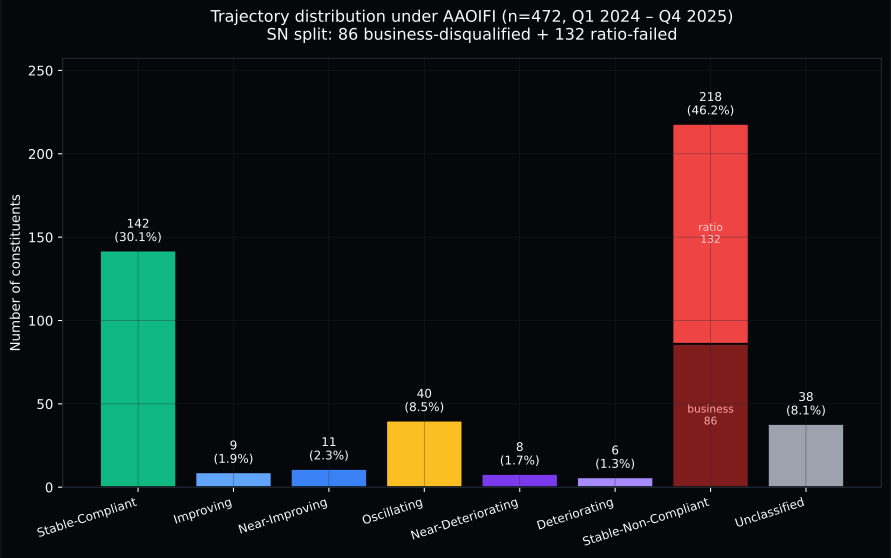
The trajectory distribution across the 467 classifiable names is sharply bimodal, with a 76-name transition layer between the poles.
| Label | Rule (formal) | Count | Share of classifiable |
|---|---|---|---|
| Stable-Compliant (SC) | compliant in all 8 quarters | 153 | 32.8% |
| Stable-Non-Compliant (SN) | non-compliant in all 8 quarters | 238 | 51.0% |
| Improving (IM) | at most 2 switches; at most 2 compliant quarters in Q1 to Q4; at least 3 compliant quarters in Q5 to Q8; Q7 and Q8 both compliant | 9 | 1.9% |
| Deteriorating (DT) | symmetric to IM: at most 2 switches; at most 2 non-compliant quarters in Q1 to Q4; at least 3 non-compliant quarters in Q5 to Q8; Q7 and Q8 both non-compliant | 8 | 1.7% |
| Near-Improving (NI) | exactly one switch, from non-compliant to compliant, ending compliant; does not satisfy IM | 10 | 2.1% |
| Near-Deteriorating (ND) | exactly one switch, from compliant to non-compliant, ending non-compliant; does not satisfy DT | 8 | 1.7% |
| Oscillating (OS) | everything else with at least one switch | 41 | 8.8% |
The 36 Unclassified names sit outside the classifiable denominator (7.2% of the 503-row universe). The two stable buckets together cover 83.7% of classifiable names; the transition layer of 76 names covers the remaining 16.3%. The 153 stable-compliant names carry 46.6% of index weight, reflecting the concentration of megacap technology in that bucket.
The four directional buckets are small enough to publish in full:
- →Improving (9): APA, CASY, GWW, HAL, HWM, IFF, VRT, WAT, WELL
- →Deteriorating (8): BALL, BG, CPAY, EMR, MRSH, PPG, TTWO, ZBH
- →Near-Improving (10): CHRW, CSGP, EQIX, EXPD, GEHC, PNR, PODD, TRMB, UAL, VRTX
- →Near-Deteriorating (8): APTV, DGX, DOW, FISV, NDSN, PAYX, PH, UPS
The Oscillating bucket (41 names) is where verdict volatility concentrates: AAPL, ABNB, APH, BAX, CARR, CDNS, CRH, CRL, DASH, DELL, DOV, DPZ, DVN, ED, EQR, EQT, FANG, FTNT, HPE, HUBB, INCY, IT, LH, LII, LRCX, MDT, MLM, OXY, PFE, PKG, PLTR, ROK, ROST, SNPS, SWK, TMUS, TPL, VMC, VRSN, WDC, WY. These are predominantly names whose ratios live near the 30% line and cross it repeatedly as the balance sheet breathes. Apple, the largest of them, is the subject of §5.5.
Read operationally: roughly a third of the index is a low-maintenance compliant pool, roughly half is a durable exclusion list, and the product question lives in the 76-name layer that changes verdict inside a holding period. §8 quantifies what that layer implies for turnover.
5. Case Studies
Five names, one per trajectory type, each reproduced directly from the dataset. All figures are billions of US dollars for assets and debt; ratios are debt to total assets and cash to total assets. Every row below can be recomputed from SEC XBRL companyfacts under the §3 rules.
5.1 Stable-Compliant: MSFT (Microsoft)
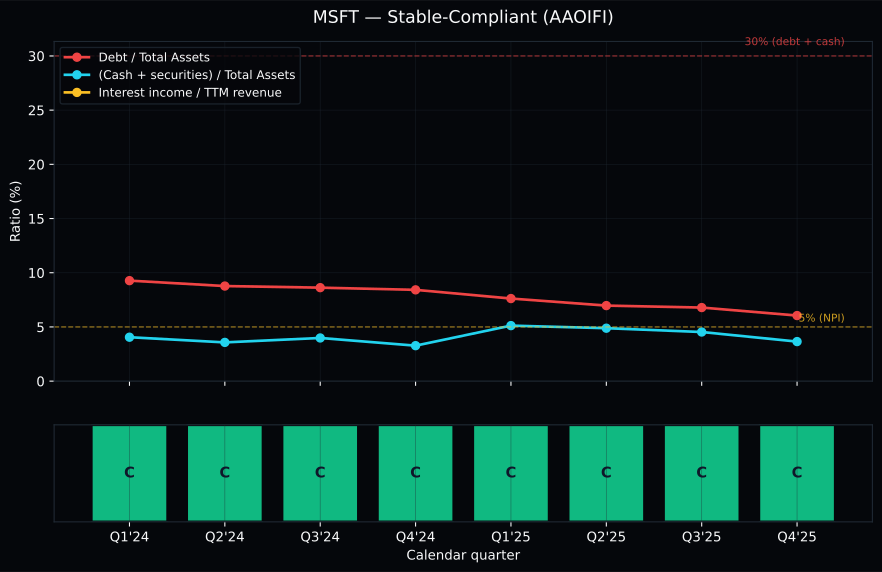
Verdict string: C-C-C-C-C-C-C-C.
| Checkpoint | Assets (B) | Debt (B) | Debt/Assets | Cash/Assets |
|---|---|---|---|---|
| 2024-03-31 | 484.3 | 65.4 | 13.5% | 4.1% |
| 2024-06-30 | 512.2 | 51.6 | 10.1% | 3.6% |
| 2024-09-30 | 523.0 | 45.1 | 8.6% | 4.0% |
| 2024-12-31 | 533.9 | 45.0 | 8.4% | 3.3% |
| 2025-03-31 | 562.6 | 42.9 | 7.6% | 5.1% |
| 2025-06-30 | 619.0 | 43.2 | 7.0% | 4.9% |
| 2025-09-30 | 636.4 | 43.2 | 6.8% | 4.5% |
| 2025-12-31 | 665.3 | 40.3 | 6.1% | 3.7% |
Microsoft is the unremarkable case made remarkable by scale, and it is actively deleveraging in ratio terms: debt to assets falls from 13.5% to 6.1% across the window. The mechanism is both ends of the fraction: absolute debt declines from USD 65.4 billion to USD 40.3 billion while total assets grow from USD 484.3 billion to USD 665.3 billion as the AI capex cycle expands the balance sheet. Cash to assets stays in a narrow 3.3% to 5.1% band. Both ratios sit far inside the 30% threshold in every quarter, the core business passes the activity screen, and no plausible single-year balance-sheet event threatens the verdict. This is what a structurally low-maintenance holding looks like, and the stable-compliant bucket broadly shares the profile: conservative debt against a large asset base, treasury cash rather than a strategic cash mountain.
5.2 Stable-Non-Compliant: ABBV (AbbVie)
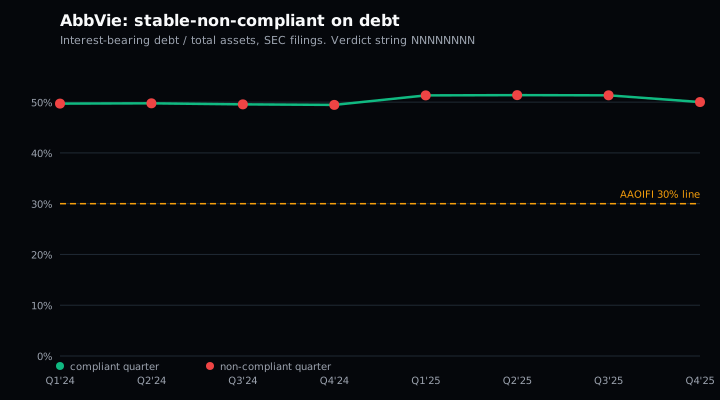
Verdict string: N-N-N-N-N-N-N-N.
| Checkpoint | Assets (B) | Debt (B) | Debt/Assets | Cash/Assets |
|---|---|---|---|---|
| 2024-03-31 | 148.9 | 74.0 | 49.7% | 12.1% |
| 2024-06-30 | 141.9 | 70.6 | 49.8% | 9.3% |
| 2024-09-30 | 143.4 | 71.1 | 49.6% | 5.1% |
| 2024-12-31 | 135.2 | 66.8 | 49.5% | 4.1% |
| 2025-03-31 | 136.2 | 69.9 | 51.3% | 3.8% |
| 2025-06-30 | 137.2 | 70.5 | 51.4% | 4.7% |
| 2025-09-30 | 133.9 | 68.7 | 51.3% | 4.2% |
| 2025-12-31 | 134.0 | 67.0 | 50.0% | 3.9% |
AbbVie screens non-compliant on the debt ratio in every quarter, at roughly 50% of total assets, steadily. A transparency note: most of AbbVie's dataset rows carry the lease-inclusive debt flag described in §3, because its filings report combined debt-and-lease tags for the relevant instants (two quarters use the plain long-term-debt total). This is exactly the definitional detail that matters for boundary names and does not matter here: at roughly 50% debt to assets, AbbVie fails robustly under any defensible reading of the debt numerator, leases in or out. The business is permissible; the failure is purely capital structure. Names like this are why half the index belongs on a durable exclusion list rather than a quarterly re-screening queue.
5.3 Improving: WELL (Welltower)
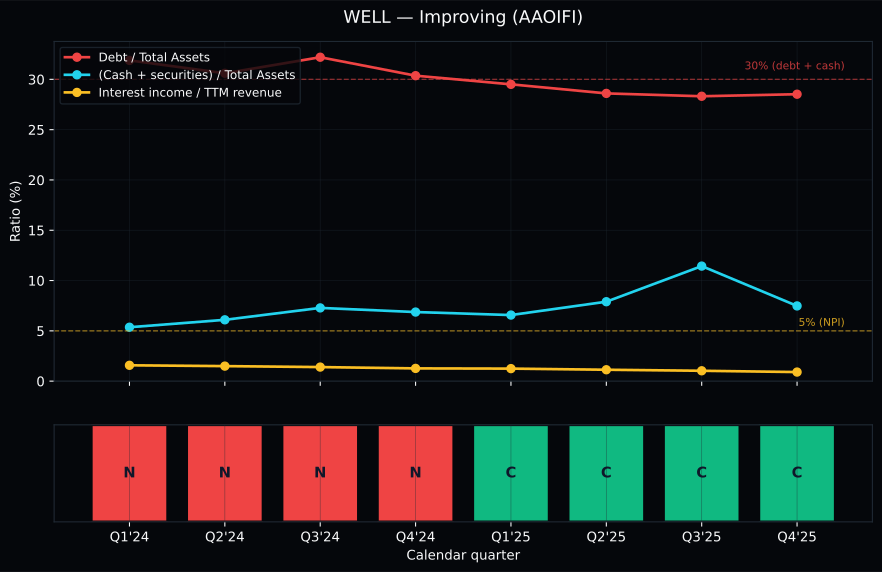
Verdict string: N-N-N-N-C-C-C-C.
| Checkpoint | Assets (B) | Debt (B) | Debt/Assets | Cash/Assets |
|---|---|---|---|---|
| 2024-03-31 | 44.6 | 14.2 | 31.9% | 5.4% |
| 2024-06-30 | 45.5 | 13.9 | 30.6% | 6.1% |
| 2024-09-30 | 49.0 | 15.8 | 32.2% | 7.3% |
| 2024-12-31 | 51.0 | 15.5 | 30.4% | 6.9% |
| 2025-03-31 | 53.3 | 15.7 | 29.5% | 6.6% |
| 2025-06-30 | 55.8 | 16.0 | 28.6% | 7.9% |
| 2025-09-30 | 59.5 | 16.9 | 28.3% | 11.4% |
| 2025-12-31 | 67.3 | 19.2 | 28.5% | 7.5% |
Welltower is the cleanest improving trajectory in the dataset. All four 2024 quarters screen non-compliant on the debt ratio (30.4% to 32.2%); all four 2025 quarters screen compliant (28.3% to 29.5%). The mechanism is visible in the columns: total assets grow 51% across the window while absolute debt grows 35%, so the ratio declines through the threshold at Q1 2025 and stays below it. This is a real capital-structure shift, funded predominantly with equity, captured by the asset-based denominator precisely because the denominator reflects the operating expansion. Note also how narrow the margin is: Welltower's compliant quarters sit between 28.3% and 29.5%, inside the 1.5-point boundary band of §1. An improving name is not the same thing as a comfortable one, and Welltower is a monitoring case even after the flip.
5.4 Deteriorating: EMR (Emerson Electric)
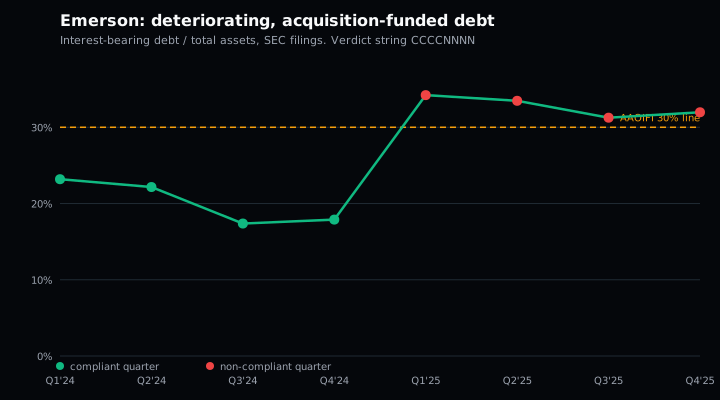
Verdict string: C-C-C-C-N-N-N-N.
| Checkpoint | Assets (B) | Debt (B) | Debt/Assets | Cash/Assets |
|---|---|---|---|---|
| 2024-03-31 | 46.4 | 10.8 | 23.2% | 5.0% |
| 2024-06-30 | 45.6 | 10.1 | 22.2% | 5.0% |
| 2024-09-30 | 44.2 | 7.7 | 17.4% | 8.1% |
| 2024-12-31 | 42.6 | 7.6 | 17.9% | 6.7% |
| 2025-03-31 | 42.0 | 14.4 | 34.2% | 4.5% |
| 2025-06-30 | 42.5 | 14.2 | 33.5% | 5.2% |
| 2025-09-30 | 42.0 | 13.1 | 31.3% | 3.7% |
| 2025-12-31 | 41.9 | 13.4 | 32.0% | 4.2% |
Emerson replaces UPS as the deteriorating case study, and it is the cleaner illustration: a single, dated, acquisition-funded debt event with no definitional ambiguity. Through 2024 Emerson deleverages, with debt falling to USD 7.6 billion and the ratio reaching 17.9% at Q4 2024. Then in Q1 2025 debt jumps from USD 7.6 billion to USD 14.4 billion in a single quarter, funding acquisition activity, against an asset base that does not grow. The ratio moves from 17.9% to 34.2% in one step and the verdict flips from compliant to non-compliant, where it remains for the rest of the window (31.3% to 33.5%). This is the structural counterexample to Welltower: Welltower grew assets faster than debt, Emerson grew debt against a flat asset base. Deteriorating names typically mark a strategic event in progress, and a screen that checks annually would have carried Emerson as compliant for up to a year after the event.
5.5 Oscillating: AAPL (Apple)
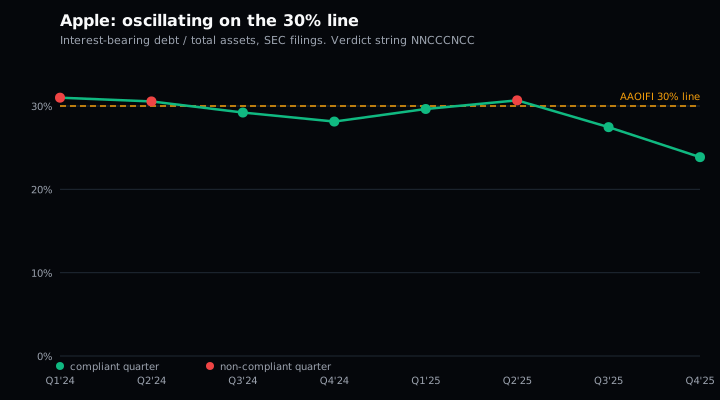
Verdict string: N-N-C-C-C-N-C-C.
| Checkpoint | Assets (B) | Debt (B) | Debt/Assets | Cash/Assets |
|---|---|---|---|---|
| 2024-03-31 | 337.4 | 104.6 | 31.0% | 9.7% |
| 2024-06-30 | 331.6 | 101.3 | 30.5% | 7.7% |
| 2024-09-30 | 365.0 | 106.6 | 29.2% | 8.2% |
| 2024-12-31 | 344.1 | 96.8 | 28.1% | 8.8% |
| 2025-03-31 | 331.2 | 98.2 | 29.6% | 8.5% |
| 2025-06-30 | 331.5 | 101.7 | 30.7% | 10.9% |
| 2025-09-30 | 359.2 | 98.7 | 27.5% | 10.0% |
| 2025-12-31 | 379.3 | 90.5 | 23.9% | 11.9% |
Apple is the study's clearest line-hugger. The data shows something untidy on purpose: Apple spends five of eight quarters within 1.5 points of the 30% line (31.0%, 30.5%, 29.2%, 29.6%, 30.7%), crossing the line three times over the window, before the ratio breaks lower to 27.5% and then 23.9% as debt is retired against a growing asset base. The honest reading is twofold. First, for most of the window Apple's verdict is definition-sensitive: at 29.6% or 30.7%, reasonable variations in the debt numerator flip the answer, and a screen reporting a bare C or N at those checkpoints is reporting its own definitional choices as much as Apple's balance sheet. Second, the window ends unambiguously: at 23.9% debt to assets, Apple exits 2025 clearly compliant under this methodology, with genuine room to the threshold for the first time in the window. The verdict string looks erratic; the ratio path shows a line-hugger resolving into compliance, and oscillators like this are the strongest argument for surfacing ratio trajectories next to verdicts.
6. Transition Drivers
Across the classifiable ratio-screened names, 145 quarter-to-quarter verdict transitions occurred in the window: 70 from compliant to non-compliant and 75 from non-compliant to compliant, spread across 76 distinct names. (Transitions are counted as quarter-pairs across the seven adjacent checkpoint pairs, so a multi-switch oscillator contributes multiple events.)
The driver decomposition, published in full so the arithmetic is checkable:
| Driver | C to N | N to C | Total |
|---|---|---|---|
| Debt only | 56 | 54 | 110 |
| Cash only | 12 | 20 | 32 |
| Debt and cash combined | 2 | 1 | 3 |
| Total | 70 | 75 | 145 |
The debt ratio is involved in 113 of 145 transitions (110 debt-only plus 3 combined), which is 77.9%, nearly four in five. Cash is involved in 35 (24.1%). The two figures sum to more than 100% because the 3 combined events count in both.
What this rules in and out:
- →Debt-ratio events dominate in both directions. Issuers either add net debt against a slower-growing asset base (Emerson, §5.4) or let the asset base outrun the debt stack (Welltower, §5.3). The near-symmetry of the debt column (56 outbound, 54 inbound) says the boundary population churns in both directions rather than draining one way.
- →Cash events are real but second-order, and skew toward re-entries. Cash-only events split 12 outbound against 20 inbound: cash-rich names near the 30% cash line more often deployed cash and re-entered compliance than accumulated through it.
- →Combined breaches are rare. Only 3 of 145 events involve both ratios in the same quarter.
- →The denominator is a silent driver inside the debt tag. When a ratio falls through 30% with absolute debt roughly flat, the driver still codes as debt, because the debt ratio is the ratio that moved. The cause, however, was asset growth. This is the strongest case for showing users total assets alongside debt and cash: without the denominator visible, a user infers a debt event that may not have occurred.
The pace matters for §8: the 70 compliant-to-non-compliant events over seven quarter-pairs average 10.0 outbound events per quarter. A screened portfolio drawn from this universe should expect roughly ten compliance exits per quarter as a base rate, before any methodology-specific buffers.
7. Sector Anatomy
Sector labels below follow the dataset's sector classification; 16 names without a sector assignment are grouped as Unclassified sector. Counts are names per trajectory label.
| Sector | Total | SC | SN | IM | DT | NI | ND | OS | UC |
|---|---|---|---|---|---|---|---|---|---|
| Technology | 80 | 45 | 16 | 0 | 1 | 1 | 1 | 12 | 4 |
| Industrials | 71 | 21 | 28 | 3 | 1 | 4 | 3 | 6 | 5 |
| Financial Services | 65 | 0 | 65 | 0 | 0 | 0 | 0 | 0 | 0 |
| Healthcare | 59 | 23 | 23 | 1 | 1 | 3 | 1 | 6 | 1 |
| Consumer Cyclical | 53 | 15 | 23 | 0 | 1 | 0 | 1 | 5 | 8 |
| Consumer Defensive | 32 | 13 | 15 | 0 | 1 | 0 | 0 | 0 | 3 |
| Utilities | 31 | 2 | 28 | 0 | 0 | 0 | 0 | 1 | 0 |
| Real Estate | 31 | 3 | 15 | 1 | 0 | 2 | 0 | 2 | 8 |
| Communication Services | 24 | 6 | 15 | 0 | 1 | 0 | 0 | 1 | 1 |
| Energy | 21 | 7 | 5 | 2 | 0 | 0 | 0 | 5 | 2 |
| Basic Materials | 20 | 10 | 4 | 1 | 1 | 0 | 1 | 3 | 0 |
| Unclassified sector | 16 | 8 | 1 | 1 | 1 | 0 | 1 | 0 | 4 |
| Total | 503 | 153 | 238 | 9 | 8 | 10 | 8 | 41 | 36 |
Three patterns dominate.
Financial Services zeroes out, entirely on the business screen. All 65 Financial Services names are stable-non-compliant, and every one of them is excluded on activity rather than ratios: banks, insurers, asset managers, and consumer-finance issuers whose business models rest on interest spreads or conventional underwriting. The ratio screen is the wrong tool for this sector; the activity screen is binding, and it is binding permanently.
Utilities fail on capital structure. 28 of 31 Utilities names are stable-non-compliant. Capital-intensive regulated infrastructure carries structural debt loads well above 30% of assets, and the sector shows almost no transition activity (one oscillator, two stable-compliant outliers). Like Financial Services, this is a durable exclusion, but for balance-sheet rather than activity reasons.
Technology anchors the compliant pool. 45 of 80 Technology names are stable-compliant, the highest count and rate of any sector, and the sector also contributes the largest block of oscillators (12), names whose treasury and M&A activity keeps ratios near the line. Industrials (21 SC, 28 SN, and the largest directional-transition population: 3 IM, 4 NI, 3 ND, 1 DT) is where the transition layer is busiest, consistent with debt-funded capacity cycles and acquisitions. Healthcare splits evenly (23 SC, 23 SN) between capital-light pharma and device names on one side and activity-excluded insurers plus leveraged acquirers on the other.
The implication for index construction is direct: an AAOIFI-screened S&P 500 product is structurally a sector-tilted product. Financial Services and Utilities drop almost entirely, Technology is retained at a little over half the sector, and the monitoring workload concentrates in Industrials, Technology, and Healthcare, where the transition layer lives.
8. Implications for ETFs and Monitoring
For screened-fund construction. The 16.3% in-window transition rate sets the order of magnitude of compliance-driven turnover that a quarterly-screened product must absorb. The recomputed pace: the window averages 10 compliant-to-non-compliant events per quarter (§6), and the operationally relevant compliant pool is roughly 172 names (153 stable-compliant plus the 9 Improving and 10 Near-Improving names that end the window compliant). Ten outbound events per quarter from a pool of roughly 172 is roughly 6% of the held universe flipping outbound per quarter. A fund that screens annually does not avoid this turnover; it defers it, and holds non-compliant names for up to a year in the interim. Emerson (§5.4) is the concrete case: the debt event lands at Q1 2025, and an annual screen dated mid-2024 carries the name as compliant until mid-2025.
Buffers and boundary names. The 82 boundary names of §1 are where methodology choices bite. A fund can drop a name on every breach quarter (maximum turnover, maximum fidelity), hold through single-quarter breaches with a tolerance band (less turnover, some non-compliant holding periods), or apply trajectory-aware rules that treat an Emerson (step change, no recovery) differently from an Apple (line-hugger resolving upward). All three are defensible; the choice should be disclosed, because with 7.5% of all ratio-quarters within 1.5 points of the line, the choice is worth real basis points of turnover and real days of non-compliant exposure.
For purification. Standard purification practice computes a non-permissible fraction of dividend income and donates it, implicitly assuming a stable compliance state across the holding period. A holder of Welltower since Q1 2024 collected distributions through four non-compliant quarters and four compliant ones; a holder of Emerson, the reverse. Purifying at the current verdict's rate under-purifies one and over-purifies the other. This study does not propose the doctrinal rule (that belongs to Shariah boards), but no rule can be applied without the quarter-by-quarter record, and point-in-time screens do not produce one.
For screening platforms. A binary verdict answers "does this name screen compliant today". The trajectory data answers "has this name screened compliant across my holding period, and what drove the changes". The 76-name transition layer, the 82 boundary names, and the driver decomposition in §6 are all product surfaces that a verdict-only platform hides. The practical monitoring rule follows directly from the boundary finding: for names within roughly 1.5 points of the threshold, a single-quarter verdict should be read as provisional, and what deserves attention is the ratio path and the debt events behind it. That is the design principle behind the Halal Terminal screening surfaces: verdicts shipped with their ratios, their definitions, and their history.
9. Limitations
Snapshot-of-membership universe. This study screens the current published holdings of an S&P 500 tracker, not a reconstruction of historical index membership over the window. Worth naming plainly: the current-holdings universe has survivorship exposure (names that left the index during the window are absent; recent joiners are screened over quarters before they joined), while a membership reconstruction cannot be independently verified because the membership record is not public. We chose reproducibility over survivorship purity: every row in this universe traces to a published holdings file and a public CIK mapping anyone can re-derive.
36 names are Unclassified. 7.2% of the universe could not be classified because at least one quarter was missing a required balance-sheet component under the §3 extraction rules. These names are excluded, not imputed. The classifiable shares reported throughout use the 467-name denominator.
Debt-definition sensitivity, including finance leases. The primary debt numerator excludes finance lease obligations; the documented fallback for combined-tag issuers includes them, flagged per name. For most names this is immaterial (AbbVie fails at roughly 50% under any reading). For boundary names it can decide the verdict, which is exactly why UPS was reclassified rather than presented as a clean case study. Readers who hold a different view on leases can identify every affected name from the dataset flags and recompute.
Boundary names are definition-sensitive generally. 221 ratio-quarters across 82 names sit within 1.5 points of the 30% line. For those observations, threshold choice, denominator choice, and numerator composition all matter. This study's verdicts near the line are claims about the stated methodology, not about the companies in any definition-independent sense.
NPI is not re-screened historically. The Halal Terminal engine screens non-permissible income point-in-time in production, but this study did not re-screen NPI at each historical checkpoint. A mid-window NPI breach would not appear as a transition here. Debt and cash dominate transition activity in large-cap US names, but the gap is real and stated.
Eight quarters is short, and the study is educational. Two years is enough to demonstrate that verdicts move and to measure the base rate; it is not enough to estimate stable long-run transition probabilities. And as the legal notice states: this is educational research under a disclosed methodology, not a fatwa, and not a recommendation to transact in any name mentioned.
10. Appendix: Reproducibility
Dataset. Two CSV files constitute the dataset behind every figure in this paper:
- →
sp500-aaoifi-v2-master.csv(one row per name: CIK mapping, sector, eight-quarter verdict string, trajectory label, per-name debt-tag and cash-tag flags, failure reasons); SHA-256:f3a740783bd316bd0414a23f54d301d9b1644eafbb5287d3bb132c1f578d4814 - →
sp500-aaoifi-v2-timeseries.csv(one row per name per checkpoint: total assets, debt, cash, both ratios, verdict, failure reason, source-tag flags); SHA-256:85b2c43ae5c52eb7fb3cf1d31bedd5449f515a43631ffaece4e62e4d91518fb8
Anyone receiving the files can verify exact correspondence with this paper by comparing the hashes.
Taxonomy rules, restated formally. Let the verdict string be eight quarters Q1 to Q8, each C or N; a switch is any adjacent pair with different verdicts.
- →SC: all eight quarters C.
- →SN: all eight quarters N.
- →IM: at most 2 switches; at most 2 C quarters in Q1 to Q4; at least 3 C quarters in Q5 to Q8; Q7 and Q8 both C.
- →DT: symmetric to IM: at most 2 switches; at most 2 N quarters in Q1 to Q4; at least 3 N quarters in Q5 to Q8; Q7 and Q8 both N.
- →NI: exactly one switch, from N to C (so the string ends C), and the string does not satisfy IM.
- →ND: exactly one switch, from C to N (so the string ends N), and the string does not satisfy DT.
- →OS: any remaining string with at least one switch.
- →UC: any name with at least one unclassifiable quarter (missing required component); assigned before the rules above and never imputed.
Failure-reason coding.
- →Debt: interest-bearing debt / total assets at or above 30%
- →Cash: cash and cash equivalents / total assets at or above 30%
- →Business: core activity excluded by the Halal Terminal engine's activity classification
- →Combined: concatenation (for example "Debt+Cash") where multiple ratios breach in the same quarter
- →Missing: required component not extractable; the quarter is unclassifiable and the name is UC
Headline counts any recomputation must reproduce: 503 universe rows; classifiable 467; SC 153, SN 238 (138 by ratios, 100 by business), IM 9, DT 8, NI 10, ND 8, OS 41, UC 36; 145 transitions (70 C to N, 75 N to C) across 76 distinct names; drivers 110 debt-only, 32 cash-only, 3 combined; debt involved in 113 of 145 (77.9%); 221 boundary ratio-quarters of 2,936 (367 ratio-screened classifiable names x 8 quarters; 7.5%) across 82 names.
Data on request. The dataset, the extraction rules as implemented, and the pre-publication verification log are available on request to Shariah boards, academic researchers, and journalists reproducing or challenging the study. Contact Yassir at yassir@halalterminal.com. Disagreement with a verdict is welcome; the request we make is that it arrive with an alternative rule stated as explicitly as §3.
Explore the Data
The screening engine behind this study runs live on Halal Terminal. Per-name verdicts with their underlying ratios are on the stock screening pages, fund-level holdings screening is on the ETF pages, and the full screener, watchlists, and portfolio monitoring are in the Terminal. The companion point-in-time study, a full-universe snapshot of the S&P 500 as of 2026, is at /research/sp500-halal-2026.
References
Footnotes
- →
Islamic Corporation for the Development of the Private Sector (ICD) and LSEG, Islamic Finance Development Indicator Report 2025. Industry-asset figure verbatim from the report: "the industry has expanded its footprint to 140 countries by 2024 and reached a valuation of US$5.98 trillion, marking an impressive 21% growth in just one year"; projection verbatim: "If growth continues at current levels, a figure of US$9.7 trillion is forecast by 2029." ↩
- →
Accounting and Auditing Organization for Islamic Financial Institutions (AAOIFI), Shari'ah Standard No. 21: Financial Papers (Shares and Bonds), 2004 edition. The thresholds applied in this study are the Halal Terminal production engine's documented reading of the standard, as stated in §3. ↩
Key Findings (Non-Prescriptive)
- 1Bimodal distribution — 32.8% stable-compliant, 51.0% stable-non-compliant (of 467 classifiable names). The remaining 16.3% is the trajectory bucket.
- 2Debt dominates transitions — nearly four in five of the 145 verdict transitions in 2024–2025 involved the debt ratio (113, 77.9%); cash accounted for the rest.
- 3Business screen does the heavy lifting on SN — 100 of 238 stable-non-compliant names (42%) are excluded on business activity (conventional finance, insurance, tobacco, entertainment, defense and similar); the other 138 fail on the financial ratios, overwhelmingly debt-to-assets.
- 416.3% turnover floor — Of 467 classifiable names, 76 (16.3%) changed verdict at least once in the window — the structural floor on rebalancing turnover for any quarterly-cadence AAOIFI-screened S&P 500 product.